
Mainoo’s late strike seals 3-2 Manchester United win over Liverpool and confirms Champions League return
Old Trafford thriller ends with Mainoo as the difference
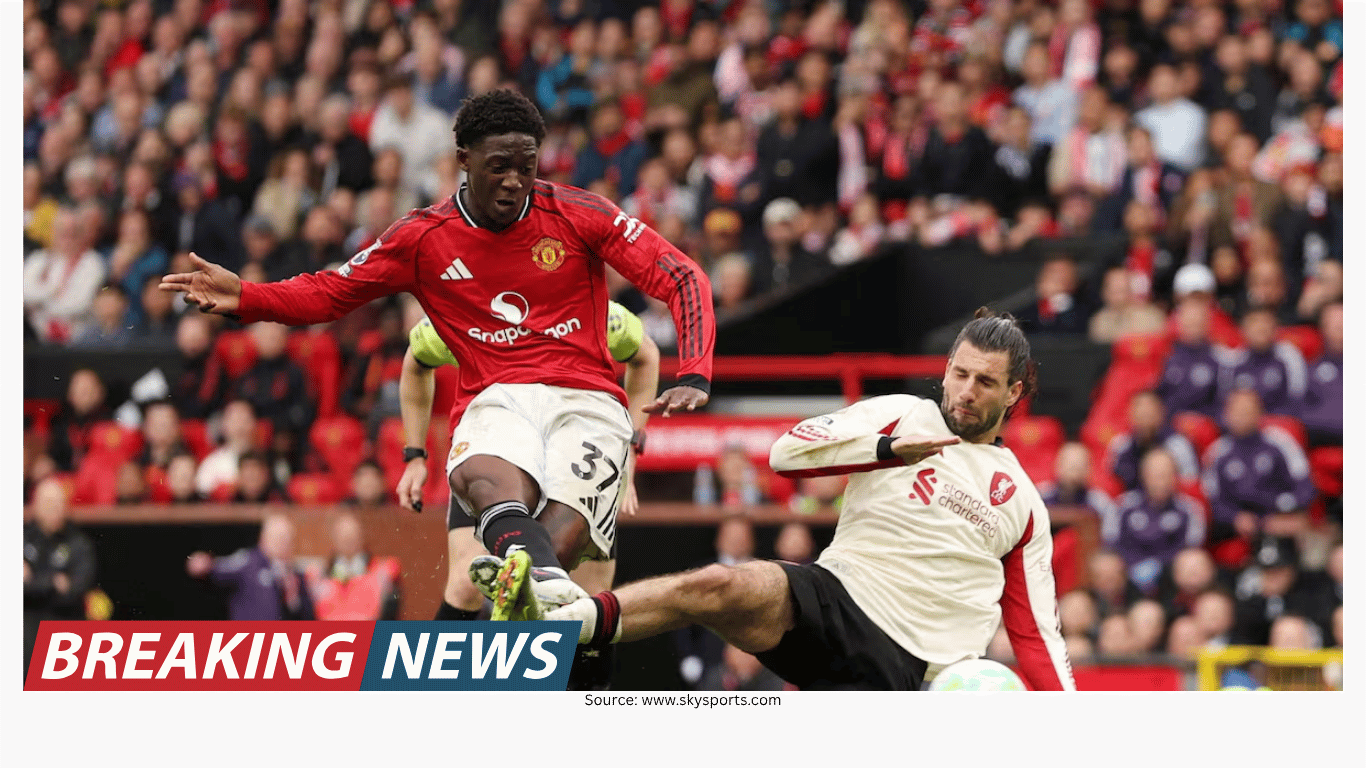
Manchester United and Liverpool produced a five-goal Premier League contest at Old Trafford that swung repeatedly before Kobbie Mainoo delivered the decisive moment. Mainoo’s hard, low finish from the edge of the box secured a 3-2 victory for United in front of an attendance of 74,027, capping a match that moved from early United control to a Liverpool fightback and then back again.
The win carries significant weight for United. The three points confirm Champions League football next season as they tighten their grip on third place in the table. Liverpool, meanwhile, remain fourth with work still to do, and the performance added further scrutiny on head coach Arne Slot as he looks to convince supporters he is the right man to lead the club into the next campaign.
Mainoo was named Player of the Match, and his winner was the final act in an afternoon that also included debate over a possible handball in the build-up to United’s second goal, as well as pointed post-match comments from Slot about VAR decisions and refereeing patterns across the season.
United strike twice, Liverpool left with a mountain to climb
United’s early play brought reward through Matheus Cunha, whose left-footed shot deflected off the back of Alexis Mac Allister and beyond Liverpool goalkeeper Freddie Woodman. The deflection proved decisive, wrong-footing Woodman and giving United an important foothold in a rivalry match that rarely allows teams time to settle.
United soon doubled their advantage. Benjamin Sesko forced the ball home after Bruno Fernandes’ centre was pushed into his path by Woodman. In the moment, it looked like a classic case of pressure creating uncertainty: Fernandes delivered into a dangerous area, the goalkeeper could not fully clear, and Sesko reacted first.
At 2-0, United appeared to have the game under control. But the match would not follow a straightforward script. Liverpool, who had started without a trio of forwards that Slot felt could have made a difference, stayed in the contest and waited for the opening that would eventually arrive after the break.
Liverpool’s comeback: two mistakes, two punishments
The second half turned into a different game, shaped by errors and swift punishment. United squandered their two-goal advantage, and Liverpool’s route back was helped by two costly moments.
The first came from substitute Amad Diallo, who had just entered the match. Diallo gifted the ball to Dominik Szoboszlai, and the Liverpool midfielder made United pay with a fine solo goal. It was the type of strike that changes both the scoreboard and the mood inside a stadium: a single piece of quality, sparked by a turnover, that immediately reopens a contest.
Liverpool then levelled when Senne Lammens’ poor kick was seized upon, allowing Cody Gakpo to bring the score to 2-2. In a rivalry match where momentum is everything, the equaliser completed Liverpool’s comeback from two down and left the closing stages wide open.
With the game balanced, it became a test of nerve and execution. Both teams had reason to believe they could win it, and both had already shown vulnerabilities. In that context, one clean strike could decide the outcome.
Mainoo’s winner and a personal storyline
That decisive strike came from Mainoo. When the ball fell to him on the edge of the penalty area, he fired hard and low beyond Woodman to restore United’s lead at 3-2. The finish was direct and composed, and it proved enough to settle an “anybody’s game” that had been teetering between two outcomes.
Mainoo’s contribution also carried a personal narrative. He had been frozen out of the team by Ruben Amorim, yet here he was stealing the show under Michael Carrick. In a match filled with big names and high stakes, it was the youngster who delivered the defining moment.
Speaking afterwards, Mainoo framed the win as a collective achievement and pointed to belief in the manager as a driving factor.
“To turn it around the way we have done, it’s a credit to the players and the manager,” he said. “We are just looking forward and still need to finish the season strong.
“We want to just keep on winning and winning … The confidence in not just me but all the players. You want to follow him and fight for him. That’s what we showed today.”
Champions League secured as United strengthen third place
Beyond the drama of the 90 minutes, the result has clear consequences for the league picture. United’s victory confirms they will play in the Champions League next season, a key objective and a marker of progress. The report noted that they have tightened their grip on third spot, turning the Old Trafford win into more than just a rivalry triumph.
For Carrick, the wider meaning was also hard to ignore. Former United captain Roy Keane had suggested before kick-off that the result would “have a big bearing on whether Michael Carrick will get the job”. After a performance defined by pace, purpose and resilience—despite the wobble after half-time—the sense around Old Trafford was that this could be an important step in Carrick’s case.
VAR debate: Liverpool frustration over Sesko goal
The match also left Liverpool with a grievance. Slow-motion replays later indicated that Sesko may have got a “feather-like touch” on the ball with his hand before his goal. During the VAR process, the initial replays shown did not appear to include that close-up view, and the goal was allowed to stand.
Slot was asked in his press conference whether the goal should have been disallowed. His answer focused on both the specifics of the incident and the broader question of interpretation.
“If it was a touch, which I think it is, because if you know a bit about a ball sport, you know that if a ball has a certain curve and the curve changes, there must have been a contact,” he said. “But it’s always like that.
“We should have a debate in football. Is that enough to disallow a goal? But I think the rule is if there was a touch, it should have been disallowed.”
Slot also argued that marginal calls have repeatedly gone against Liverpool this season, describing it as a pattern. He referenced examples involving Paris Saint-Germain, a penalty decision, and an incident in which his goalkeeper was on the floor injured and play was not stopped. He contrasted that with a moment in this match when a United player was off the pitch and the referee stopped the game as Liverpool tried to play on.
However, Slot also stressed that Liverpool’s problems were not limited to refereeing decisions. “But the second goal we did not concede because of the handball,” he said. “We conceded it because we lost the ball in a stupid position and we lost a few big moments afterwards in duels.
“So we have to first look at ourselves. That would be completely clear and obvious.”
Liverpool’s bigger concern: identity, approach and away-day patterns
Even with the late disappointment of conceding the winner, Liverpool’s performance raised wider questions that go beyond one moment or one decision. The assessment surrounding Slot is that the club is in transition, but the concern among fans is not the concept of transition itself—it is what the team is transitioning into.
The discussion centred on style and identity. Liverpool supporters want to see a side that presses, and it was pressing that sparked their brief comeback. The idea of tweaking the model established by Jurgen Klopp is one thing; the fear is that a “sterile possession game” could represent a divergence too far.
There was also a pointed critique of Liverpool’s away form, described as becoming less of a blip and more of a pattern. The first-half approach on the road was characterised as passive and at odds with the club’s identity, with Liverpool too often reactive rather than proactive.
That concern is underlined by a stark statistic included in the match coverage: Liverpool now have just four goals in their last 19 first halves. The issue was framed as more than finishing—more a collective lack of urgency, with slow tempo and disjointed pressing.
In the context of a club expected to challenge for major honours, those trends were described as an embarrassing quirk in what has been a difficult season. For Slot, the task is twofold: address the patterns that are within the team’s control while also navigating the frustration that comes from contentious decisions.
Carrick, Ferguson news and an emotional backdrop
The day at Old Trafford carried an emotional undertone following news that Sir Alex Ferguson had been taken to hospital before kick-off after feeling unwell. Carrick was asked about the situation after the match and said he had no update, but expressed concern and support.
“Well, I haven’t got any update so I don’t know the latest as we stand now,” Carrick said. “I did hear about it before the game so I was aware of it before the game.
“All I can say is I wish him the best. I’m very affected by it, the news, and I just hope he’s alright. I just don’t know the latest but we hope for him to be in good shape and we wish him all the best.
“We certainly think that hopefully the result, when he hears about it, can give him a boost.”
For many supporters, the match became something to savour not only because of the scoreline but because of the sense of occasion around it. The report suggested Carrick has United playing with “pace and purpose of old”, a description that, against the backdrop of Ferguson’s illness, added poignancy to the performance and offered hope for the team’s future.
Key performers and match ratings
Mainoo’s decisive role was reflected in the individual assessments. He was named Player of the Match and scored the winner, while Cunha’s early goal and Szoboszlai’s second-half strike stood out as major moments in the game’s flow.
- Manchester United: Senne Lammens 5, Diogo Dalot 7, Harry Maguire 7, Heaven 7, Luke Shaw 6, Casemiro 7, Kobbie Mainoo 8, Bruno Fernandes 7, Matheus Cunha 8, Bryan Mbeumo 6, Benjamin Sesko 7. Subs: Amad 5, Dorgu 5, Zirkzee n/a, Yoro n/a.
- Liverpool: Freddie Woodman 6, Jones 5, Virgil van Dijk 5, Ibrahima Konate 5, Andrew Robertson 6, Ryan Gravenberch 6, Dominik Szoboszlai 8, Alexis Mac Allister 5, Frimpong 5, Wirtz 5, Cody Gakpo 7. Subs: Kerkez 6, Ngumoha 6, Chiesa n/a.
Those numbers reflect a match where individuals influenced the narrative in contrasting ways: match-winning quality at one end, and costly errors at the other. For United, the challenge will be to retain the attacking intent that brought them two early goals while reducing the mistakes that allowed Liverpool back into the contest.
For Liverpool, the second-half response showed spirit and pressing intensity, but the broader concerns about slow starts and away-day approach remain unresolved. With the table still tight around the Champions League places, the stakes of those patterns are only likely to grow as the season reaches its conclusion.